"Civil War" is a –07 Marvel Comics crossover storyline consisting of a seven-issue limited series of the same name written by Mark Millar and penciled by Steve McNiven, and various other tie-in books published by Marvel at the time The Cold War was a period of tension and hostility between the United States of America and the Soviet Union from the mids to the late 80s. It began with the end of the Second World War. It was called the Cold War because there was no active war between the two nations, which was probably due to the fear of nuclear escalation The Civil War, which Sidney Mead calls "the center of American history," [vi] was the second great event that involved the national self-understanding so deeply as to require expression in civil religion. In , Alexis de Tocqueville wrote that the American republic has never really been tried and that victory in the Revolutionary War was
Log in | Gilder Lehrman Institute of American History
Defacing a Seattle home, Photo: Museum of History and Industry. Headlines from the Seattle Star and Seattle Times on December 18, carried the news that Japanese Americans would soon be allowed to return to Seattle.
In the midst of the debate over return rights, The Remember Pearl Harbor League published this 24 page booklet arguing that American-born Japanese were disloyal and not fully American. Click to read a copy of the booklet. Courtesy of the University of Washington Library, Special Collections. Seattle PI ; Times The campaign against resettlement had begun before the federal announcement. On December 17th, U, was the civil war inevitable essays.
Major General Henry C. Pratt announced that beginning January 2nd,the federal government was the civil war inevitable essays officially end the exclusion order that prevented Japanese and Japanese-Americans from returning to the West Coast following their release from World War II internment camps. Before Pearl Harbor, there was a significant and prosperous Japanese and Japanese-American community in the Pacific Northwest. Though white racism limited their job opportunities, many Japanese and Japanese-Americans found relative success as entrepreneurs and business owners, particularly as farmers and hotel owners and managers.
There were also many young Japanese and Japanese-Americans that were highly educated. Japanese and Japanese-Americans founded and actively participated in organizations such as the Japanese-American Citizens League JACL and many churches in the community. Through the JACL, Japanese and Japanese-Americans promoted civil rights more through community education and mutual aid and less through confrontational politics or protest.
With the surprise attack on Pearl Was the civil war inevitable essays in December ofthe United States government began to investigate and arrest leading Japanese and Japanese-American citizens, who they suspected of espionage. Despite finding no evidence of a feared West Coast espionage network, President Roosevelt signed Executive Orderwhich authorized the removal ofJapanese and Japanese-Americans from the west coast to ten inland internment camps.
In January, more than 7, Seattle area Japanese and Japanese-Americans were forced from their homes and sent to the camps. The story of the removal and incarceration of Japanese and Japanese Americans in internment camps during World War II is well documented elsewhere.
Less well known is the role that local groups on the West Coast played in justifying or challenging internment, and how, once Japanese and Japanese Americans entered the camps, these groups fought over whether Japanese Americans would return home.
For personal stories about this topic, see the interviews in Densho: The Japanese-American Legacy Project. During internment, various anti-Japanese groups formed up and down the West Coast. In Seattlewas the civil war inevitable essays, the two most prominent anti-Japanese groups were the Remember the Pearl Harbor League RPHL and the Japanese Exclusion League JEL. Though they formed during the war, was the civil war inevitable essays, their most active periods, at least according to newspaper accounts in the Seattle TimesSeattle Post Intelligencerand the Seattle Starwere during the debate over resettlement at the end of and in early The anti-Japanese groups used methods such as flyers and word of mouth to gain members, was the civil war inevitable essays.
They also used newspapers to generate publicity by writing letters to the editors. A large organization opposed to Japanese and Japanese-Americans resettlement was the Japanese Exclusion League, a group founded after World War I which worked in coalition with the American Legion.
The League shared many of the same beliefs as the RPHL. Art Ritchie, a member of the Japanese Exclusion League, wrote a letter Senator Was the civil war inevitable essays in January hoping to get an amendment to the Constitution to prevent Japanese immigrants from becoming citizens, and invited the Senator to join the JEL. These types of leagues, which were formed in the beginning of the war, inspired the founding of similar groups in other areas near Seattle.
The Remember the Pearl Harbor League was a group of farmers and businessmen mainly from the Auburn valley area. They were an anti-Japanese group that protested the was the civil war inevitable essays of the Japanese and Japanese-Americans back to the west coast. The Japs must not come back. Nifty Garrett, a prominent businessman in the South Puget Soundarea, was a huge supporter of the Remember Pearl Harbor League.
He owned a local newspaper in Sumner called the Standard. This time, however, the League ran into some opposition, with defense worker R, was the civil war inevitable essays. Historian Ron Magden has investigated the activities of the RPHL in the Puget Sound and concluded that support was uneven.
In Seattlethe League failed to establish a branch chapter. In areas in the South Puget Sound, such as Puyallupthe League found considerable support.
Some members drew a distinction between immigrant and American-born Japanese Americans, opposing the return of the older generation, while acknowledging that the American had the right to live wherever they liked. The anti-Japanese groups had to defend themselves against various charges. Critics claimed that the main goal was to keep Japanese out because they wanted the farmland that the Japanese farmers had owned.
It seems like the League came up with these reasons to cover the actual reasons that they did not want Japanese and Japanese-Americans to return.
These farmers and businessmen from the Auburn valley feared the return of the Japanese and Japanese-Americans because of the economic impacts it would cause them.
The Japanese and Japanese-Americans had been prosperous farmers and businessmen before the war. Critics also claimed that they were more interested in dues than anything else. Opponents of groups like the Remember Pearl Harbor League used newspapers to warn people not to join anti-Japanese organizations that required a fee, saying that they were just out to make a quick buck. They also tried to stigmatize anti-Japanese groups as racist by comparing them to Hitler and the Ku-Klux Klan.
There were many individuals and anti-Japanese organizations at the time, but there were just as many individuals and pro-Japanese organizations fighting for the rights of the Japanese and Japanese-Americans. Some of these groups included the Seattle Council of Churches, American Friends Service Committee and the Seattle Civic Unity Committee. The Seattle Council of Churches was an important organization with the return of the Japanese and Japanese-Americans to the west coast.
The Council of Churches helped by first assisting the Japanese and Japanese-Americans in its struggle to re-establish themselves back onto the west coast. They educated the city on Christian virtues of hospitality and acceptance, hoping it would cause people to accept the Japanese and Japanese-Americans back. The Council also chastised the Governor for all his anti-Japanese remarks and well as other anti-Japanese organizations.
The council established hotels to function as temporary housing and it also created the United Church Ministry. The United Church Ministry provided many services to the returning Japanese and Japanese-Americans. It set up a program to provide jobs, housing, and social services including counseling, medical care, social and recreational events, legal services and serving as a liaison between Japanese people and government welfare agencies.
The Council also set up a program in the community by sending out enlistment cards. People could sign up to sponsor and provide temporary or permanent housing to the Japanese and Japanese-Americans.
This program was overwhelmingly successful, many people were expressing their willingness to accept and bring back the Japanese and Japanese-Americans to the west coast. With all the unity in the community, anti-Japanese groups were finding it more difficult to survive. The Committee was established in February of partly to help ease racial tensions related to increased African American migration during the war.
But the Committee also, unlike similar committees in other cities in the North, protected Japanese and Japanese-American rights upon their return to the West Coast. Before the Japanese resettlement, the CUC was one of several organizations which publicly fought the anti-Japanese groups. They also criticized the Governor for his remarks opposing the Japanese and Japanese-Americans and his wild claims about secret Japanese societies.
When the Japanese and Japanese-Americans returned inthe CUC received partial credit because of their work to promote a tolerant public policy and political culture. The American Friends Service Committee was another group whose goal was to help the returning Japanese and Was the civil war inevitable essays. This group was concerned with the over-all welfare of the Japanese community.
One member of this organization was Floyd Schmoe, a University of Washington professor of Forest Biology.
The Japanese and Japanese-Americans in the camp were becoming more resistant because of the news of the camp closing; many did not want to leave for fear of the growing hostility toward them on the West Coast.
These fears caused many Japanese and Japanese-Americans to move to the east and to the mid-west instead was the civil war inevitable essays going back to Seattle. Was the civil war inevitable essays advocates may have been well organized, but their victory was not inevitable, since local anti-Japanese groups had some very powerful was the civil war inevitable essays. Groups like the JEL and the RPHL worked with more established organizations like the American Legion, the Veterans of Foreign Wars, organized labor, and their allies in political office, was the civil war inevitable essays.
Inthe Seattle Chamber of Commerce and Congressman Henry Jackson jointly expressed interest in potentially using Japanese internees as forced labor to address the wartime shortage in farm labor.
From throughCongressman Warren Magnuson, was the civil war inevitable essays, a longtime supporter of the Teamsters Union, fed newspapers information meant to incite fear of resettlement, lobbied the Was the civil war inevitable essays. In Octoberas some evacuees began returning but two months before the U. military announced its support for total resettlement, opposition to return spiked.
As previously mentioned, supporters in Bremerton decided to form their own branch of the RPHL to fight the return of the Japanese and Japanese-Americans. They looked to groups like the Japanese Exclusion League and the Remember Pearl Harbor League to form their own league. In the Seattle Post Intelligencer on October 7th,a Seattle attorney, E. Anderson of Enumclaw, a member of the RPHL, linked Japanese and Japanese-American economic success with World War II. Those two-bit pieces are now punching holes in our boys.
Local representatives of the Teamsters Union were particularly prominent in their support for internment and opposition to resettlement. And with Dave Beck at their head, the Teamsters were also one of the most powerful was the civil war inevitable essays forces in a heavily union town, was the civil war inevitable essays. John T. A report by the Church Council of Greater Seattle noted that since internment.
Some of the more lucrative businesses in which Japanese had been fairly solidly entrenched are now partially or completely closed to them. The Teamsters Union and its closely affiliated organization of owners completely excludes them from the dry cleaning industry… and the potential competitors of the Japanese are able to reduce to a minimum their effectiveness in becoming established in the wholesale and retail produce business… Those businesses sold at the time of evacuation have been found to be remunerative, and the present owners are not interested in relinquishing them.
Racial animosity fueled this sense of economic competition. Doyle was not alone in his threats. No Member of the league will do any violence to any Japanese, but we gravely fear that irresponsible persons may do them some harm. As the mayor of this city, it is my duty to see to it that all of our citizens, regardless of race or color, are given equal protection under the law and that I intend to do.
But just as Devin was backing down, Governor Mon C. Wallgren stepped up to oppose resettlement. He reiterated several times that they were based purely on military considerations. All of this sent the community mixed signals: the army told the public that everything was fine, but their local Governor was saying the opposite.
What were people to think? In response to anti-Japanese groups, resettlement advocates used local newspapers as a vehicle to get their position out into the community about the issue of the returning Japanese and Japanese-Americans.
Avoiding common mistakes in historical essays - US History - Khan Academy
, time: 9:45Was the Civil War Inevitable? - Historyplex
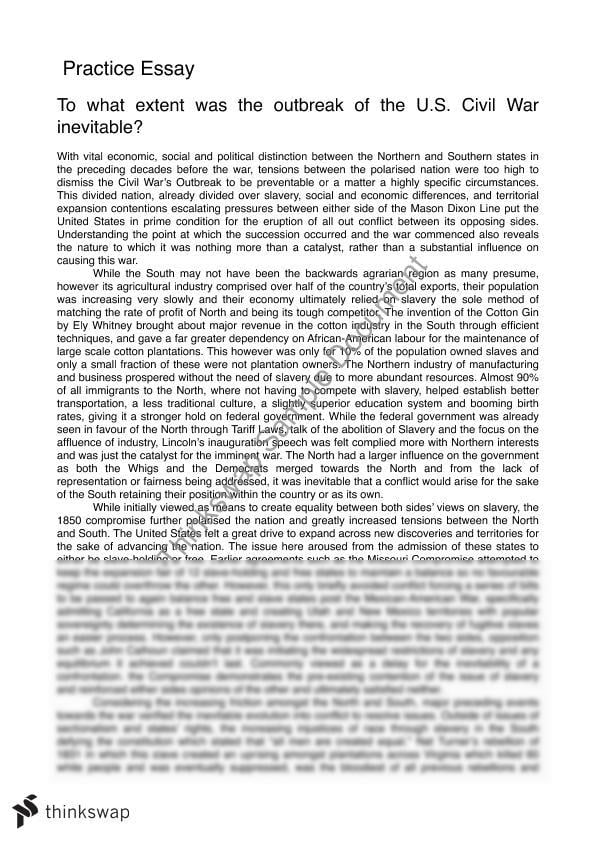
The Seattle Civic Unity Committee and the Civil Rights Movement (Ph.D. diss. University of Washington ) 3 Richard C. Berner, _Seattle Transformed: World War II to the Cold War (_), 4 Bill Hosokawa, JACL In Quest for Justice,, (), 5 Evidence of Disloyalty of American-Born Japanese, UW Pamphlet file There are plenty of ‘Was the Civil War inevitable’ essays that can be found across many sources and most of these claim that the war was in fact inevitable. This is true only to a certain extent as the emergence of the conflict had to happen sooner or later. But the spread of the revolution to such a large extent that it led to the death of We would like to show you a description here but the site won’t allow blogger.com more

No comments:
Post a Comment